The first time a customer called me during an ice storm, panicked because his brand-new generator had run fine at the store, the problem was not the generator at all. It was a 20-pound propane tank sitting in single-digit weather, barely able to push out enough vapor to keep the thing running. He thought he’d bought a lemon. He’d actually bought a physics lesson.
Cold does strange things to fuel. Propane gets lazy, diesel turns to jelly, and gasoline that sat in the tank since summer picks that exact moment to gum up a carburetor. None of it is complicated once you know what’s happening, but it catches a lot of folks off guard on the worst possible night.
I spent twelve years wiring and servicing backup power in a part of the country where winter means business. What follows is the stuff I wish every homeowner knew before the first hard freeze.
Key takeaways
- Propane loses vapor pressure as it gets colder, so a small tank can starve your generator below about 20°F.
- Diesel gels in the cold unless it is treated or blended for winter; keep an anti-gel additive on hand.
- Old gasoline is the number one cold-weather no-start I see, so stabilize it or drain it before winter.
- Where you put the tank and how full you keep it matters as much as which fuel you burn.
Why generator fuel and cold weather do not always get along
Every fuel behaves differently when the mercury drops, and the failures show up in different ways. Understanding which one you’re feeding your generator tells you exactly what to watch for.
Propane is a vapor problem. Diesel is a flow problem. Gasoline is a freshness problem. Mix those up and you’ll fix the wrong thing at 2 a.m. in a headlamp.
If you’re still deciding what to run, it’s worth reading our breakdown of generator fuel types compared before winter locks in your choice. The right fuel for a mild climate is not always the right fuel for a cold one.
Propane: the tank size trap
Propane is my favorite fuel for backup power in most cases, but it has one honest weakness in the cold. Propane has to boil off into vapor before your generator can burn it, and that boiling slows way down as the tank gets cold. Below about 20°F, a standard 20-pound grill-style tank can’t produce vapor fast enough to keep a mid-size generator fed.
The generator sputters, surges, and eventually quits. People assume the tank is empty. It’s often half full.
The fix is bigger tanks, not more tanks
A larger tank has more liquid surface area boiling off vapor, so it keeps up in the cold far better than a small one. A 100-pound cylinder or a stationary 250-gallon tank will run a home generator through a deep freeze without breaking a sweat. That’s why nearly every permanent standby install I did used a big fixed tank.
Never bring a propane cylinder indoors or into an attached garage to “warm it up.” That’s how people end up with leaks and carbon monoxide in living space. Keep tanks outside, upright, and clear of snowdrifts, and run the generator at least 20 feet from doors and windows.
If you’re weighing propane against a piped-in supply, our comparison of natural gas versus propane generators walks through how each holds up when it’s cold, and the pros and cons of propane generators piece covers the tank-sizing math in more detail.
Diesel: keep it flowing
Diesel packs a lot of energy and lasts a long time in storage, which is why it’s a workhorse for larger backup systems. Its cold-weather catch is gelling. As diesel cools, the paraffin wax naturally in the fuel starts to crystallize, and those crystals clog filters and fuel lines. The temperature where it starts is the “cloud point,” usually somewhere around 15°F to 32°F for untreated summer diesel.
On a job one January, I found a standby diesel unit that wouldn’t crank past a rough idle. The fuel filter was packed with what looked like candle wax. The owner had filled it in August and never touched it.
Winterize before you need it
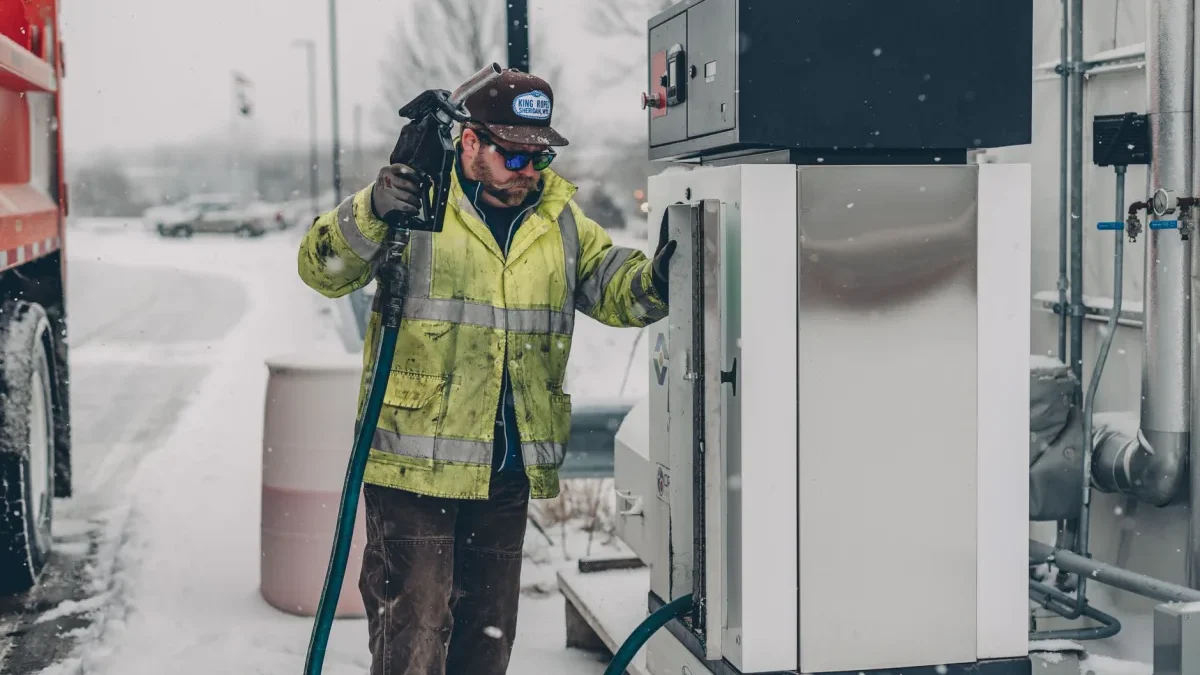
Two habits solve almost all of it. First, run winter-blend diesel or add an anti-gel treatment rated for your lowest expected temperature; a bottle runs about 10 to 15 dollars and treats a lot of fuel. Second, keep the tank topped off so there’s less room for condensation to form water, which freezes and blocks lines before the diesel even gets a chance to gel.
If diesel is new to you, the guide to diesel generators for home backup covers sizing and storage habits that pair well with these cold-weather steps.
Add anti-gel treatment before the cold hits, while the fuel is still liquid and flowing. Pouring it into already-gelled diesel does almost nothing; the wax has already dropped out.
Gasoline: the enemy is time, not just temperature
Most portable generators run gasoline, and the cold-weather failure I see more than any other has a simple cause: stale fuel. Gas starts breaking down in as little as 30 days, and the varnish it leaves behind clogs the tiny jets in a carburetor. Then a cold morning, when the engine is already hard to start, is when it finally refuses.
A mistake I see all the time is a homeowner filling up in September, never running the unit, and being stunned it won’t fire in December.
Keep gas fresh with a stabilizer added at fill-up, and run the generator for 15 minutes once a month so fresh, treated fuel cycles through the whole system. If your unit will sit unused for the season, run it dry or drain the carburetor bowl instead. For the basics of these machines, the beginner guide to portable generators is a good starting point.
How the three fuels stack up in the cold
| Fuel | Main cold-weather issue | Simple prevention |
|---|---|---|
| Propane | Low vapor output from small tanks below ~20°F | Use a 100-lb or larger tank; keep it clear of snow |
| Diesel | Gelling as wax crystallizes near the cloud point | Winter blend or anti-gel additive; keep tank full |
| Gasoline | Stale fuel varnishing the carburetor | Stabilizer, monthly run, or drain for storage |
Your quick pre-freeze fuel checklist
Run through this before the first hard freeze, not during it. Twenty minutes on a mild afternoon beats an hour in the dark with cold hands.
- Confirm your propane tank is large enough and at least half full.
- Clear a two-foot path around any outdoor tank so snow can’t bury the regulator.
- Add winter-rated anti-gel to diesel and top the tank off.
- Dose fresh gasoline with stabilizer, or drain the old fuel out.
- Start the generator and let it run 15 minutes under a small load.
- Check the oil; cold-thick oil strains the starter and battery.
That last one trips people up. A weak battery and cold, sluggish oil will stop a perfectly good generator from starting even when the fuel is spotless. Regular servicing catches it, and our complete generator maintenance checklist lays out the full seasonal routine.
Get ahead of the next cold snap
Pick the one fuel you actually run and do its winter prep this week, while it’s still an easy job. If that’s propane, size up the tank. If it’s diesel, buy a bottle of anti-gel today. If it’s gas, add stabilizer and run the unit for a quarter hour.
For the full rundown on safe cold-weather operation and carbon monoxide, the U.S. Consumer Product Safety Commission keeps a solid reference at cpsc.gov, and Ready.gov has a clear power outage preparedness page worth bookmarking. Do the small stuff now, and the next ice storm is just weather instead of an emergency.