
The first ice storm I worked as a young electrician, I watched a family run their brand-new 3,000-watt generator into the ground trying to power a well pump that wanted 4,800 watts to even start. It tripped, it stalled, it never had a chance. They’d bought on price alone, and it cost them a cold weekend.
That’s the trap with backup power. The unit that looks like a deal on the shelf is often the wrong size, the wrong fuel, or missing the one feature that would’ve mattered at 2 a.m. in January.
So here’s how I’d shop for the best portable generator for home use if I were standing in that aisle with you, based on twelve years of installing and servicing these things.
Key takeaways
- Size by starting watts, not running watts, motors (fridge, furnace, well pump) surge 2-3x on startup.
- For most homes, a 5,000-7,500 running-watt inverter or open-frame unit hits the sweet spot on price and capability.
- Fuel type decides how long you can actually run: propane stores forever, gas is convenient, dual-fuel gives you both.
- Budget $600-$1,500 for a solid unit, plus a transfer switch or interlock so you’re not running dangerous extension cords.
Start with a real watt count, not a guess
Sizing is where nine out of ten buyers go wrong. They read “5,000 watts” on the box and assume that’s what they get. It isn’t, that number is usually the surge rating, and the continuous (running) number is what keeps things on.
A mistake I see all the time: adding up running watts and stopping there. Anything with a motor draws a big gulp of extra power for a half-second when it kicks on. A refrigerator that runs at 150 watts can spike past 1,200 to start its compressor.
Walk your house and add it up. Here’s a rough load list I use with homeowners.
| Appliance | Running watts | Starting watts |
|---|---|---|
| Refrigerator | 150 | 1,200 |
| Gas furnace blower | 600 | 1,800 |
| Sump pump (1/2 hp) | 1,050 | 2,150 |
| Well pump (1/2 hp) | 1,000 | 2,000 |
| Lights + phone/router | 300 | 300 |
| Microwave | 1,000 | 1,000 |
Add your running watts, then add the single largest starting surge on top. For most homes that lands somewhere between 5,000 and 7,500 running watts. If you want the full walkthrough on load math, our beginner guide to portable generators for home backup breaks it down step by step.
Never run a generator in a garage, basement, or near an open window. Carbon monoxide from these engines kills people every year, the CPSC recommends keeping the unit at least 20 feet from the house with the exhaust pointed away. Get a battery CO alarm for your living space, no exceptions.

Inverter or open-frame? It depends on what you’re running
Two main flavors sit on the shelf, and they solve different problems.
Inverter generators
These produce clean, stable power (low total harmonic distortion, usually under 3%), which matters for laptops, modern TVs, and anything with a circuit board. They’re quieter, a good 3,000-watt inverter runs around 57 decibels, about the level of a normal conversation. They also sip fuel by throttling the engine down when the load is light.
The catch is price. You pay a premium, and the biggest inverters top out lower than open-frame units. A Honda EU2200i runs near $1,300 for 1,800 running watts, which is a lot per watt.
Open-frame conventional generators
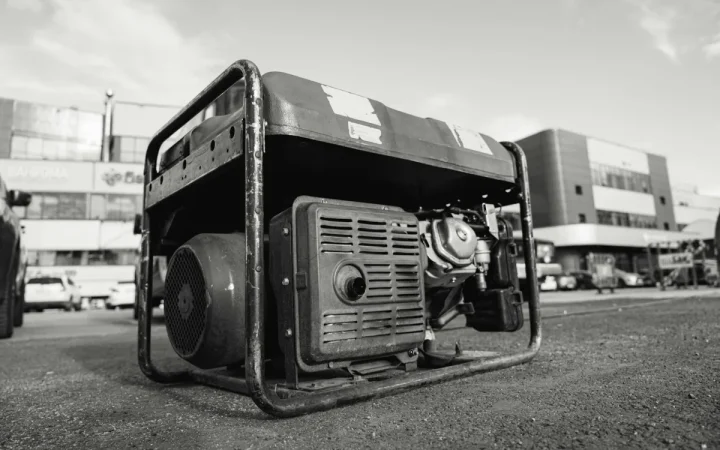
These give you more raw watts per dollar and handle big surges well. A 7,500-watt open-frame unit from Champion or Westinghouse often lands under $900. They’re louder (around 72-74 dB) and their power is a little dirtier, but for a furnace, a well pump, and a fridge, that’s fine.
My honest recommendation for a first generator: a dual-fuel open-frame in the 6,500-7,500 watt range, or a large inverter if noise and sensitive electronics are your priority.
Fuel type is really a runtime decision
People obsess over brand and forget that fuel dictates how long the lights stay on. Three options matter.
- Gasolineeverywhere and easy, but it goes stale in 3-6 months and you’re stuck at the pump during a widespread outage.
- Propanestores for years in a tank, burns cleaner, and you can keep three or four spare 20-lb cylinders in the shed. Slightly less power output than gas.
- Dual-fuelruns on either. This is what I put on most jobs now because it gives you options when one supply runs dry.
On a job last winter, a homeowner rode out a four-day outage on propane alone because gas stations within thirty miles had no power to pump. The dual-fuel unit paid for itself that week. If you’re weighing gas against propane against diesel, our rundown of generator fuel types goes deeper, and the runtime guide shows how tank size and load change the hours you actually get.
Look for a generator that runs at 25% load for at least 8-10 hours on a tank. That’s an overnight run without you getting up at 3 a.m. to refuel in the cold. A larger tank often beats a bigger engine for real-world comfort.
The connection matters as much as the generator
Here’s the part the box doesn’t tell you. A generator is only as useful as how you get its power into the house, and this is where I see the most dangerous shortcuts.
Running a spider web of extension cords through a cracked window works for a fridge and a lamp. It does not work for a furnace or a well pump, both of which are hardwired. And backfeeding, plugging a generator into a wall outlet to energize your panel, can kill a lineman working to restore your power. Don’t ever do it.
The right answer is a manual transfer switch or an interlock kit installed at your panel by a licensed electrician, usually $500-$900 with labor. It lets you power hardwired circuits safely and legally. Our walkthrough on connecting a portable generator to your house covers both methods, and if you must use cords, the guide to extension cords and gauges keeps you from melting a 16-gauge cord under a 2,000-watt load.
What you’ll actually spend
Let me lay out honest numbers so nothing surprises you at checkout.
A capable dual-fuel unit in the 6,500-7,500 watt range runs $600 to $1,500 depending on brand and features. Add $500-$900 for a transfer switch installed. Budget another $60-$150 for a heavy 10-gauge generator cord, and keep $40 in fuel stabilizer and spare oil on the shelf.
That puts a real, safe setup around $1,200 to $2,500 all in. It’s not nothing, but compared to a whole-house standby system, which runs $5,000 to $15,000 installed, as covered in our complete standby generator guidea portable is a lot of protection for the money.
How I’d pick one this weekend
If you’re staring at options right now, do this. Add your critical loads and find your surge number. Pick a dual-fuel unit rated 20-30% above that. Then book an electrician for an interlock before the next storm season, not during it.
Buy the connection and the fuel storage at the same time as the generator, those are the pieces people skip and regret. For sizing and safety references straight from the source, the U.S. Department of Energy’s guidance on home backup power and Ready.gov’s power outage preparedness page are both worth a read before you buy.
Get the sizing right and the connection safe, and a good portable will carry your family through nearly anything the grid throws at you.