Most people don’t think about how they’ll move a generator until they’re actually trying to move one. I’ve watched a homeowner drag a brand-new 7,500-watt unit across a gravel driveway by the handle, scraping the housing and pinching a finger in the process. That machine weighed 205 pounds. Nobody moves that alone without help.
A wheel kit fixes that. It’s the cheapest upgrade you can bolt onto a generator, and on the jobs I ran as an electrician, it was the difference between a unit that got used and one that sat in the garage because moving it was a hassle.
So let’s talk about wheels, handles, tire types, and the small stuff that trips people up. I’ll keep it practical, because that’s how I learned it.
Key takeaways
- A portable generator wheel kit usually costs $30 to $80 and takes about 30 minutes to install with basic hand tools.
- Solid or “never-flat” foam tires beat pneumatic tires for a machine that sits for months between uses.
- Match the kit to your exact model number, not just the wattage class, or the bolt holes won’t line up.
- Anything over roughly 120 pounds really needs wheels and a folding handle to move safely.
What a portable generator wheel kit actually includes
A typical kit has two rear wheels, an axle, two front feet or a small caster, a folding handle, and a bag of bolts. That’s it. The whole thing bolts to the steel frame that already surrounds your generator.
The rear wheels carry the load and the front feet keep it level when it’s parked. You tilt the unit back like a hand truck and roll it. On a well-designed kit, one person can move a 200-pound machine over a flat driveway without straining.
Where it gets frustrating is fitment. A 3,500-watt inverter and a 9,000-watt open-frame unit are built completely differently, and their frames have different bolt patterns. If you’re still deciding what size machine you need, work that out first using our rundown on how much wattage a portable generator needs, then buy the wheel kit to match.
Universal kits vs. model-specific kits
Manufacturers sell model-specific kits that drop right in. Champion, Westinghouse, and DuraMax all do this, and the bolts line up on the first try. I like these because there’s no guessing.
Universal kits are cheaper and claim to fit “most” generators. Sometimes they do. More often you’re drilling a new hole in the frame or shimming a bracket, which is fine if you’re handy but annoying if you expected fifteen minutes and a wrench.
Write down your generator’s full model number before you shop. “Champion 7500” isn’t enough; there are several 7,500-watt Champions with different frames. The plate is usually near the fuel tank or on the control panel.
Tire types, and why solid tires usually win
This is where people overthink it, then buy the wrong thing anyway. You’ve got three real choices.
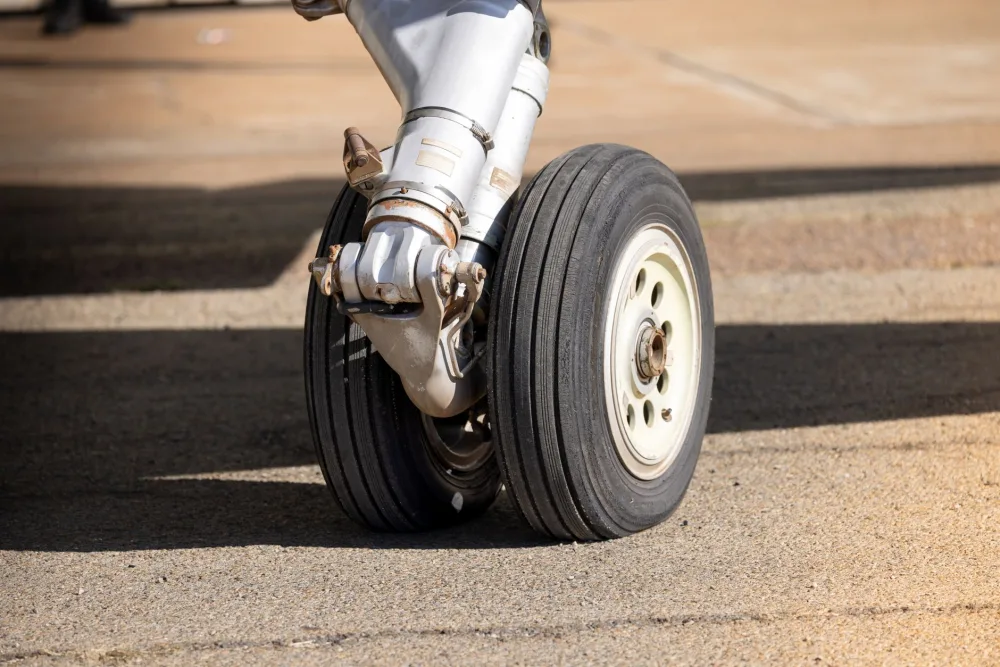
Pneumatic tires are air-filled and roll smoothly over rough ground. The catch is they go flat, and a generator that sits nine months a year almost guarantees a flat when you finally need it. On a job last winter I showed up to a customer’s ice-storm outage and both generator tires were dead flat. We aired them up, but that’s not a thing you want to be doing in a blackout with a hand pump.
Solid rubber and never-flat foam tires can’t lose air, ever. They ride a touch harder over gravel, but for a machine that lives in a garage, that trade-off is easy. I steer almost everyone toward these.
| Tire type | Best for | Watch out for |
|---|---|---|
| Pneumatic (air-filled) | Rough terrain, frequent use | Goes flat while stored |
| Solid rubber | Smooth surfaces, occasional use | Slightly rougher ride |
| Never-flat foam | Long storage, blackout duty | Costs a few dollars more |
Wheel diameter matters too. An 8-inch wheel drags in grass and gravel; a 10-inch wheel rolls over cracks and thresholds with a lot less effort. If your path to the backyard isn’t paved, size up.
Do you even need a wheel kit?
Not every generator does. A 2,200-watt inverter unit weighs around 47 pounds and has a suitcase handle. You carry that with one arm.
The math changes fast as wattage climbs. Here’s roughly where machines land:
- Under 60 lbs (2,000 to 2,500 watts): carry it, no kit needed
- 60 to 120 lbs (3,000 to 4,000 watts): a kit helps, especially over gravel
- Over 120 lbs (5,000 watts and up): buy the wheel kit, no debate
- Over 200 lbs (7,500 watts and up): wheels plus a folding handle, and clear a wide path
If you’re leaning toward a bigger dual-fuel machine because you want propane as a backup, those units run heavy, and a good kit is basically mandatory. Our piece on dual-fuel portable generators covers why the weight climbs.
Installing a wheel kit yourself
You don’t need a shop for this. A socket set, an adjustable wrench, and about half an hour will do it. I’ve done dozens and the sequence is always about the same.
The basic steps
Tip the generator onto its side or a foam block so the frame’s bottom rail faces you. Slide the axle through the frame brackets, then thread a wheel onto each end and lock it with the supplied cotter pin or nut. Bolt the front feet on next, then attach the folding handle to the opposite end.
Snug every bolt, then go back and torque them for real. Hand-tight is how you end up with a wheel wobbling off in the driveway. If your kit came with lock washers or thread-locker, use them.
Never move or tilt a generator with fuel in the tank sitting at an angle unless the cap is sealed and the fuel valve is off. Gasoline weeps out of vented caps fast. Drain it or keep it upright, and keep the machine well away from your home when running, as the CPSC warns about carbon monoxide.
Once the wheels are on, take thirty seconds to roll it around your actual storage-to-deployment path. You want to find the tight corner or the lip on the garage threshold now, not during a storm at 2 a.m.
Getting it out the door in a real outage
Wheels solve the moving problem, but placement is its own thing. You need the generator at least 20 feet from the house, away from windows and doors, on level ground where it won’t roll. That’s not me being cautious; it’s straight out of the federal guidance at Ready.gov and echoed by the Consumer Product Safety Commission.
A wheel kit makes that 20-foot rule easy to honor. When moving the machine is a fight, people cheat and put it too close, and that’s exactly how carbon monoxide tragedies happen. Before your first real run, read through how to use a portable generator safely so the whole routine is second nature.
If you’re brand new to all of this, our beginner guide to portable generators for home backup ties the pieces together, from sizing to fuel to storage.
Your next move
Go find your generator’s model plate and write down the full number. Then buy the model-specific kit if one exists, or a universal kit with 10-inch never-flat tires if it doesn’t. Set aside half an hour, torque the bolts properly, and do a practice roll to your spot.
Do that this weekend, before the season’s first storm, and you’ll never dread moving that machine again. A $50 kit and thirty minutes buys you a generator you’ll actually use when the lights go out.