The first question homeowners ask me is almost never about power. It’s “How loud is this thing going to be?” And honestly, that’s the right instinct. You’ll hear your standby generator far more often than you’ll ever need it in a blackout, because it runs a self-test every week whether the sun is shining or not.
I spent twelve years wiring these units into houses across the Midwest, and I’ve stood next to hundreds of them running. The spec sheets tell you part of the story. Your ears, your neighbor, and the local noise ordinance tell you the rest.
Let me walk you through what the numbers mean and what you’ll actually experience standing in your driveway.
Key takeaways
- Most air-cooled home standby units run around 63 to 72 dB(A) at 23 feet, roughly a normal conversation to a loud vacuum cleaner.
- Decibels are logarithmic: a 10 dB jump sounds about twice as loud, so small number differences matter more than they look.
- Placement, wall reflections, and the weekly exercise schedule affect perceived noise as much as the generator’s rating does.
- Liquid-cooled units are quieter per kilowatt but bigger; enclosure quality varies a lot between brands.
What a standby generator noise level rating actually tells you
Manufacturers publish a decibel figure measured in dB(A), almost always at 23 feet (7 meters) from the unit, running at normal exercise or partial load. That distance isn’t random, it’s a common testing standard, and it flatters the number. Stand at 7 feet instead and the same machine sounds noticeably louder.
A mistake I see all the time: people compare a “58 dB” brochure figure against a “67 dB” one and assume the first unit is a little quieter. It’s not a little quieter. Because decibels are logarithmic, every 10 dB roughly doubles the loudness your ear perceives.
Here’s a rough translation I give customers so the numbers mean something real.
| Decibel level (dB) | What it sounds like |
|---|---|
| 50 | Quiet suburban street, refrigerator hum |
| 60 | Normal conversation three feet away |
| 67-72 | Typical air-cooled home standby unit running |
| 75-80 | Vacuum cleaner or loud dishwasher |
| 85+ | Hearing protection recommended for long exposure |
So a well-rated home unit at 67 dB is loud, but it’s outdoor-loud, not lawnmower-loud. You can hold a conversation next to one. You just have to raise your voice a little.
Air-cooled versus liquid-cooled
Most homes under about 24 kW get an air-cooled unit, a fan blows air across the engine, and that fan is a big chunk of the noise. These typically land in the 63 to 72 dB range depending on the brand and enclosure.
Liquid-cooled units, common above 24 kW, use a radiator like your car. They’re quieter for the amount of power they make, but they’re also physically larger and cost more. If noise is your top concern and you have the budget, that trade can be worth it. Figuring out which size you even need is its own project, and I’d start with a proper look at how to size a generator for your home before you shop on decibels alone.
What actually changes how loud it feels
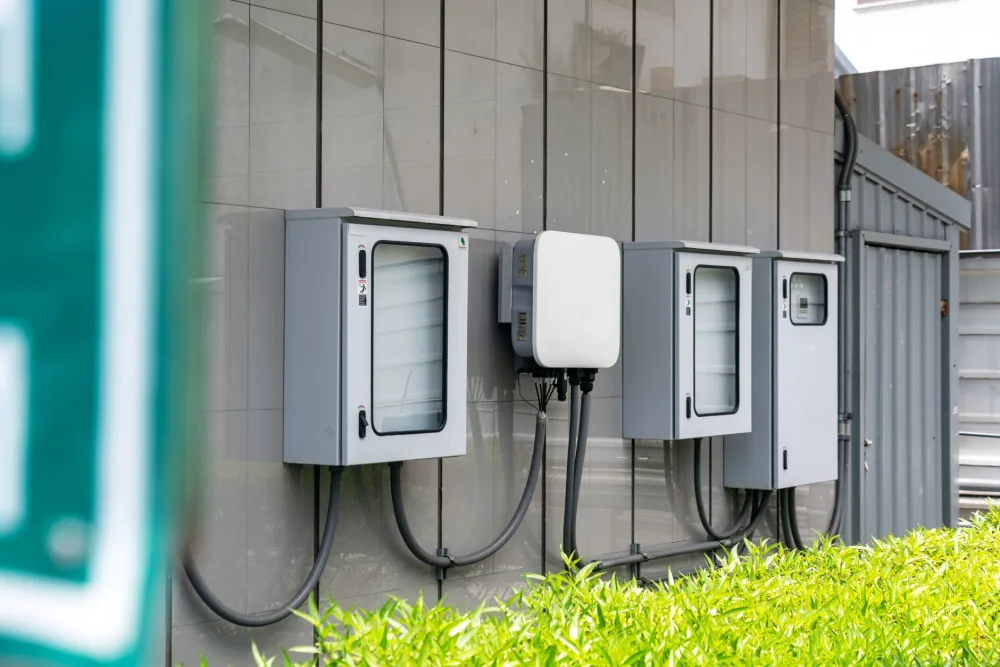
The rating is a starting point. Where the unit sits does more work than most people expect.
Sound bounces. Tuck a generator into an alcove between two brick walls and you’ve built yourself a little echo chamber, that 67 dB machine can feel like 73 at the property line. Put the same unit in the open with the exhaust pointed away from the house, and it mellows out.
On a job last winter outside Columbus, we moved a Generac unit about nine feet down the foundation, away from a corner where two walls met. Same generator, same load. The homeowner swore we’d installed a quieter model. We hadn’t. We’d just stopped the sound from ricocheting.
- Point the exhaust and radiator discharge away from bedrooms and patios.
- Keep the unit out of tight corners where two walls meet.
- Respect the manufacturer’s clearances, usually 18 inches to 5 feet, for both airflow and service access.
- Set it on a level, solid base so the frame doesn’t buzz or rattle.
- Check your local ordinance for a nighttime decibel limit at the property line.
That last point trips people up. A lot of towns cap noise at 55 to 65 dB at the property line after 10 p.m. Your weekly exercise cycle can be reprogrammed to run at a civil hour, and I’ll get to that. A solid, code-compliant base matters here too, a loose pad transmits vibration, so it’s worth reviewing the concrete pad requirements for a standby generator before the crew pours anything.
Never quiet a generator by boxing it in or blocking its vents. These engines produce carbon monoxide and need airflow to cool. The CPSC has documented deaths from generators operated too close to homes, keep exhaust pointed away from doors, windows, and vents, and follow the manufacturer’s clearance spec exactly.
The weekly test nobody warns you about
Every standby generator runs a self-exercise cycle, usually once a week for 5 to 20 minutes. This is normal and good, it keeps the oil circulating and the battery charged. But if it’s set for 9 a.m. Sunday, your neighbor will notice.
Most controllers let you pick the day, the time, and on newer units a “quiet test” mode that runs the engine at a lower RPM. I set nearly every one I install to a weekday, mid-morning or mid-afternoon, when people are at work and ambient noise is already up.
Ask your installer to enable quiet-test or low-speed exercise mode if your unit supports it. On several models it drops the weekly test from around 66 dB to the high 50s, a real, audible difference for a five-minute setting change.
One more thing on this: keep a note of when that test runs. Twice now I’ve had customers call about a “generator problem” that turned out to be the neighbor’s dog reacting to the scheduled 8 a.m. test. Move the time, problem solved, no service call needed.
How much does quieter cost?
Noise-focused features aren’t free, but they’re rarely the biggest line on the invoice. A composite or acoustically lined enclosure might add $200 to $600 over a base steel one. Stepping from a 22 kW air-cooled unit to a quieter liquid-cooled model, though, can add several thousand dollars once you count the larger pad and heavier wiring.
My honest advice: get the placement and exercise schedule right first, because those cost nothing and fix most complaints. Then spend on hardware if you still need it. If you’re weighing this against a cheaper, noisier option you wheel out only during outages, our breakdown of standby versus portable generators lays out that trade plainly, and beginners often find the portable generator starting guide a useful gut check.
Whatever you buy, read the fine print on coverage before you sign, enclosure and cosmetic parts sometimes carry shorter terms than the engine, which is worth knowing up front. Our rundown of what to know about standby generator warranties covers where those gaps usually hide.
Where to point your attention next
If you take one thing from all this, make it this: decide where the unit will live before you fall in love with a decibel number. A mid-pack rating in a smart spot beats a premium-quiet unit jammed into a corner every single time.
Walk your yard. Find the spot farthest from bedrooms and the patio, out of tight corners, with room for service clearance and a clear path for exhaust. Then ask any installer you’re quoting to confirm the exercise schedule and quiet-test options in writing.
For the full picture on sizing, fuel, and installation around that decision, our complete guide to whole-house standby generators is the next stop. And if you want an independent take on safe placement and carbon monoxide risk, the U.S. Department of Energy’s home generator guidance is a solid, plain-language reference.